Vibe coding for business: how to create solutions with AI and Uspacy without deep development knowledge
June 3, 2026
8-minute read

Dmytro Suslov
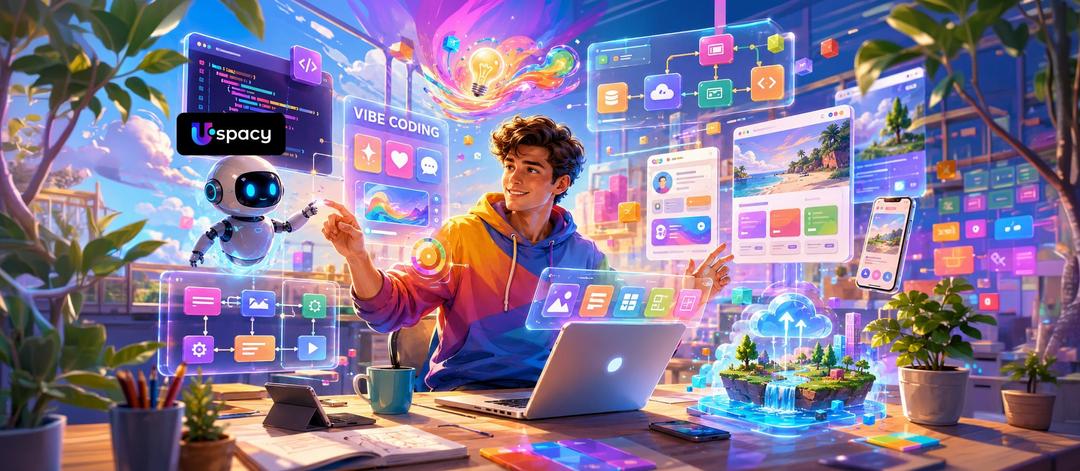
Vibe coding quickly turns an idea into a working solution using artificial intelligence, without the long cycle of traditional development. Combined with Uspacy, it gives businesses not only speed, but also an environment where new scenarios can be immediately integrated into sales, communication, task management, and automation processes.
Interest in vibe coding from businesses is growing due to a very practical need. Companies require tools that allow them to quickly adapt processes without lengthy development cycles. In this context, it is appropriate to think of Uspacy not just as a CRM, but as a comprehensive set of tools for managing sales, communication, tasks, automation, and data within a single environment.
For small and medium-sized businesses, this is particularly relevant. Simply purchasing a ready-made service is often not enough. It still needs to be tailored to specific company processes without lengthy approval chains, technical specifications, and the additional expenses of dedicated development. This is precisely where AI grants businesses a new pace of work.
The case of Uspacy illustrates this especially well. When a platform already combines a ready-to-use online service, no-code capabilities, and API integrations, artificial intelligence becomes more than just a tool for experimentation—it becomes a way to build solutions tailored to a company’s specific needs more quickly.
What is vibe coding in simple terms?
Vibe coding is an approach in which a person creates solutions not through lengthy manual development, but through an ongoing dialogue with artificial intelligence. They describe the task, provide context, refine details, test intermediate results, and gradually arrive at a working version. In this process, AI handles part of the technical work, while the person remains responsible for the content, logic, and decision-making. As a result, the value of this approach lies not in automated generation itself, but in shortening the path from an idea to a practical outcome.
For businesses, the benefits are highly practical. There is a task to solve—for example, reducing manual work, eliminating duplicate processes, speeding up calculations, or pulling data from another service. Instead of going through a lengthy cycle of requirements gathering, approvals, and multiple rounds of revisions, a company can move much faster toward a first working prototype. It may not be perfect, but it is often sufficient to validate the concept in a real-world environment.
That is why vibe coding should not be viewed merely as another way to write code. In a business context, it is an approach to building solutions—ranging from a simple calculator or form to an integration, an internal portal, or an automation workflow. And if a company already operates within an environment like Uspacy, where CRM, task management, automation, and integrations are combined in a single platform, these ideas are far easier to turn into real-world solutions rather than leaving them as yet another “interesting hypothesis.”
Why vibe coding is useful beyond technical specialists
The greatest advantage of vibe coding is that it shortens the distance between an idea and its implementation. Businesses no longer need to go through the entire lengthy process—from a verbal request to a technical specification, then development, testing, and multiple rounds of revisions. Much of this work can now be completed far more quickly: describe the task in natural language, validate the logic, review an initial result, and immediately determine whether the idea is worth pursuing further.
That is why vibe coding is valuable not only for developers. A business owner can quickly test the concept of a new service. A sales manager can design an automation workflow within a CRM system. A marketer can build a form, calculator, or simple internal tool without launching a separate multi-week project. An operations manager can describe a process in a way that is immediately turned into clear business logic rather than getting lost between requirements and implementation.
In essence, AI enhances not technical expertise, but the ability to think in terms of processes and outcomes. If someone clearly understands where their team is losing time, which tasks are repeated every day, and what result needs to be achieved, they already have a strong foundation. When this is combined with an environment like Uspacy, where CRM, task management, automation, and integrations are already built into a single platform, businesses gain more than an abstract AI experiment—they gain a practical tool for everyday operations.
Where Uspacy fits: Practical vibe coding use cases
Uspacy in this context is important not as just another CRM, but as a comprehensive set of business management tools. The platform combines a ready-to-use online service for daily operations, no-code capabilities for creating custom entities and workflows, as well as a foundation for integrations and applications. That is why vibe coding, when used together with Uspacy, does not look like an experiment for its own sake, but rather as a practical way to build solutions faster for specific company processes.
At a vibe coding webinar we organized, a Uspacy integration developer shared several scenarios that clearly illustrate the practical potential of this approach. The simplest and most straightforward example is a support calculator that replaced manual Excel-based calculations used for license recalculations. The team described the logic, provided formulas, sample input data, and the expected output, and in return received a standalone browser-based tool. As a result, the support team started responding to clients faster, became less dependent on manual work, and reduced errors in repetitive calculations.
The next level is integrations and applications built on Uspacy. Here we can clearly see how a single request gradually turns into a reusable solution. For example, an integration with YouControl solves a common business need and can function not as a one-off customization, but as a standalone installable and configurable tool. A similar logic applies to the LinkedIn case: solutions are first built for internal processes and later prove valuable for other companies as well. These scenarios show how no-code and platform capabilities in Uspacy help build not only internal customizations but also scalable applied solutions.
A more complex example is a partner portal. This is no longer a single-purpose tool, but a dedicated environment with its own logic, interaction scenarios, and multiple stages of refinement. Such solutions do not emerge on the first attempt. They require iteration, validation, adjustments, and testing. But this is exactly where the main value of vibe coding becomes clear: businesses can move faster from idea to working version and build tools tailored to their processes without overloading the core development team.
What is needed for successful vibe coding
To make this approach truly effective, no “magic prompts” are required. What is needed instead is a clear description of the task, examples of input data, and an understanding of the desired final outcome. The clearer the task definition, the more useful the response from artificial intelligence will be.
For a good start, it is worth following a few basic principles:
- Clearly define the business task.
- Describe the input data and constraints.
- Explain the expected outcome in terms of user actions.
- Provide context: examples, rules, documentation.
- Test each version and refine the requirements.
This approach removes chaos at the beginning of the process. And when the platform already includes CRM, automation, task management, and integrations, the path to a working solution becomes even shorter.
Risks of vibe coding: what to check before launch
AI speeds up development, but it does not take responsibility for the outcomes. It can simplify logic, miss edge cases, or produce a solution that only works in an ideal scenario. That is why unchecked enthusiasm can be risky.
Before launching, it is important to test access permissions, data accuracy, error handling, duplication cases, system load, and edge scenarios where things do not go as planned. If the solution works with customer data, financial information, or automated CRM actions, a dedicated testing environment should be a mandatory step. The best approach is to start with a small scenario, validate it, and only then scale it further.
How to start using vibe coding in business with Uspacy
Getting started should not involve a large transformation, but rather one painful routine. This delivers quick value and allows the team to safely test the approach in real work conditions. Some tasks can be solved using standard Uspacy tools, while others can be extended via APIs, integrations, or custom applications.
A practical starting workflow looks simple:
- Choose one repetitive action.
- Describe the process in plain language.
- Ask AI to structure the requirements.
- Check what can already be implemented in Uspacy without development.
- If needed, connect an integration or a custom application.
This approach helps move forward without unnecessary complexity. First one task, then several automations, and eventually a unified system without a patchwork of tools and constant manual duplication.
Conclusion
Vibe coding does not turn everyone into a professional developer. But it gives businesses a new rhythm: faster idea validation, less routine work, and the ability to launch useful tools without a long preparation phase. Its main value is not in “AI magic,” but in a shorter path from problem to working solution.
In combination with Uspacy, this approach becomes practical for everyday use. It is not just a CRM, but a comprehensive set of tools for sales, communication, task management, analytics, automation, and integrations. That is why the best way to start is simple: identify one manual action that slows the team down and turn it into a clear process or a dedicated solution built on Uspacy.
Updated: June 3, 2026
More materials on the topic

When artificial intelligence becomes a team member: how managers can manage the work of people and AI assistants
August 20, 2026

Modern CRM in 2026: 7 essential requirements for businesses
August 14, 2026
A voice assistant in CRM isn’t just a novelty: what sales challenges it helps solve
August 12, 2026
FAQ
What is vibe coding in simple terms?
Do you need programming skills to use vibe coding?
What business tasks is vibe coding suitable for?
How is vibe coding useful for small and medium businesses?
What role does Uspacy play in this approach?
Is Uspacy suitable for building custom solutions?
Uspacy is improving and developing at an incredible speed
Learn about product development plans
Uspacy roadmap 🚀