Not just a customer database: What tools a modern CRM system should include
June 22, 2026
6-minute read

Dmytro Suslov

A modern CRM is not just a contact database, but a space where a team can see the customer, plan next steps, communicate without losing context, and focus on results. This approach is implemented in Uspacy, where CRM is combined with tasks, activities, automation, communication, and analytics in a single environment.
The introduction of CRM in many companies starts with a simple need. You need to store contacts, avoid losing inquiries, and see which stage a deal is at. For a start, this is truly enough, because even basic order in the customer database already reduces a significant part of the chaos.
But real customer work does not end with a contact card. After an inquiry, you need to respond, record agreements, schedule the next step, assign part of the work to a colleague, and track the outcome. This is where the difference becomes clear between a simple database and a system that actually helps a team sell.
A modern CRM should not be a storage of information, but a daily working tool. It helps move a customer from the first contact to repeat sales without unnecessary switching between services or loss of context.
Customer database and sales funnel: the foundation of any CRM
Contacts, companies, leads, and deals are the foundation of any CRM system. This is where businesses typically begin bringing order to their sales process: consolidating data in one place, recording interaction history, and eliminating situations where customer information gets lost across spreadsheets, messengers, and individual notes kept by sales managers.
The next core element is the sales funnel. It shows the customer journey from initial interest to a closed deal: new lead, qualification, presentation, negotiation of terms, and payment. For managers, it is a control tool, while for sales representatives it provides a clear guide to what has already been done and what the next step should be.
In this context, Uspacy CRM helps not only store a customer database but also work with it as a living process. Within the system, users can manage contacts, companies, leads, and deals, track progress through the funnel, and quickly restore interaction context without unnecessary switching between tools. This is especially important for small and medium-sized businesses, where response speed and process transparency directly impact results.
At the same time, the customer database and sales funnel only answer the question of where the customer or deal currently stands. To move sales forward, the system must support next steps, agreements, and team actions. That is why it is important to further explore the tools that transform a CRM from a database into a daily customer management system.
Tasks and activities: how CRM helps you never lose next steps
Sales rarely stop at the stage of a contact or a recorded deal. After a conversation with a client, there is almost always a next action: call back, send a proposal, remind about a meeting, clarify details, or follow up on a specific date. If these steps are not recorded in the CRM, they quickly get lost in daily operations.
This is where it is important to distinguish between activities and tasks. Activities are actions directly tied to a client or deal: a call, meeting, follow-up, email, or reminder. Tasks are a broader team collaboration tool used when other employees need to be involved in the process: preparing a presentation, approving a document, forwarding a request to support, or involving marketing.
In Uspacy, tasks and activities can be managed directly within the context of a customer, lead, or deal. The system helps record follow-up actions, assign team tasks, track deadlines, and see who is responsible for what next. As a result, the CRM becomes not just a data storage tool, but a system that supports the team’s daily work.
This approach helps maintain momentum in sales and customer service. The manager understands the next required action, the leader has visibility into process discipline, and the client is never left without a response after the first contact. Once next steps are clearly recorded, it becomes equally important that customer communication is also fully integrated into the CRM.
CRM communications: why emails, calls, and messages should live next to the customer
Working with a customer almost always starts with communication. It can be a phone call, an email, a messenger message, a website inquiry, or a chat request. When these interactions are scattered across different tools, managers are forced to manually rebuild context every time and recall what has already been discussed.
When communications are stored inside the CRM, the team has a complete history of customer interactions. This makes it easier to respond faster, avoid repeating questions, and smoothly transfer the customer between team members. For the business, it means fewer losses in the process, and for the customer, a more attentive and consistent service experience.
In Uspacy, customer communications work directly alongside the CRM, not separately from it. Emails, calls, messages, and requests from different channels can all be viewed in the context of a specific contact, lead, or deal. This helps the team quickly restore interaction history, avoid losing agreements, and maintain consistency at every stage of the customer journey.
This approach turns the CRM into more than just a data storage system — it becomes a working environment for daily customer interactions. Managers see not isolated messages, but the full picture of engagement. And to ensure the team does not waste time on repetitive actions after each inquiry, automation and integrations play a key role in connecting processes into a unified workflow system. Get smarter responses, upload files and images, and more.
Automation and integrations: how CRM reduces routine work for teams
A modern CRM should not only store information, but also help teams perform routine actions without unnecessary manual effort. After a deal moves to a new stage, it is often necessary to create a task, send a notification, update data, or trigger an internal process. When all of this is done manually, teams spend time on repetitive work, and critical actions start to depend on the attention of individual employees.
Automation makes the process more stable and predictable. Managers are less distracted by technical operations, do not miss next steps, and can focus more on customer communication. For leadership, this means greater control: the process follows a clear logic instead of relying solely on memory and team discipline.
Integrations are equally important, because businesses rarely operate within a single tool. A CRM needs to exchange data with telephony systems, email, messengers, accounting tools, and other services already used in the company. Integrations help eliminate duplicate data entry, manual transfers, and gaps between sales, communication, and internal workflows.
In Uspacy, automation and integrations work as part of a unified environment. The system enables workflows that create tasks, change stages, update fields, send notifications, and support the required process logic. At the same time, integration capabilities allow the CRM to connect with other work tools without losing context. And once processes are properly set up, businesses need not only control over actions, but also a clear understanding of results and future growth opportunities.
Analytics and marketing tools: how CRM supports better decision-making
Without analytics, a CRM remains primarily an operational tool. It helps manage customers and deals, but does not provide a complete picture of what is working well in the process and what is slowing results down. For managers, it is important to see not only the number of contacts, but also conversion rates, team activity, stage delays, and lead sources.
Equally important are marketing tools that help work with the customer base after the first interaction. Audience segmentation, lead capture, email campaigns, and analysis of campaign responses make it possible not only to maintain communication, but also to systematically bring customers back for repeat inquiries and purchases. As a result, the CRM supports not only sales, but also the long-term development of customer relationships.
In Uspacy, analytics and marketing capabilities work in close connection with the CRM context. The system helps visualize how processes are moving, where delays occur, which areas need attention, and also manage leads and email campaigns without breaking away from the customer database. This allows teams to avoid fragmentation between data, communication, and follow-up actions across different tools.
This approach enables decisions to be made based on real operational data rather than guesswork. Businesses see not only what has already happened, but also how to improve current performance and repeat sales. Ultimately, the value of a modern CRM is defined not by the number of features it offers, but by how cohesively it supports end-to-end customer work.
Conclusion
The customer database and sales funnel remain the foundation of any CRM. However, for modern businesses, this is no longer enough. To ensure smooth performance across sales, service, and internal collaboration, a CRM must combine customer data with tasks, activities, communications, automation, integrations, analytics, and marketing tools.
A good CRM does not simply store contacts and deals. It helps provide full context for customer interactions, plan next steps, avoid missed commitments, reduce routine work, and make decisions based on real data rather than assumptions. That is why today businesses need not a standalone tracking tool, but a unified system for daily team operations.
In this approach, Uspacy is not just a CRM, but a comprehensive set of tools for managing sales, communication, and workflows in one place. Here, CRM works alongside tasks, activities, automation, analytics, and customer interaction tools, enabling teams to see the entire journey—from first contact to final result—without unnecessary switching between different systems.
Updated: June 22, 2026
FAQ
How is a modern CRM different from a simple customer database?
What tools should a modern CRM include?
How does Uspacy unlock the potential of a modern CRM?
Who is this approach to CRM for?
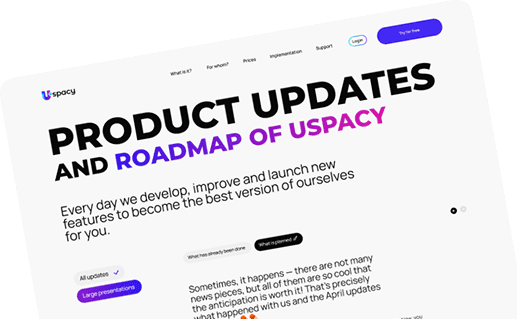
Uspacy is improving and developing at an incredible speed
Learn about product development plans
Uspacy roadmap 🚀