Lead vs. Deal in CRM: Understanding the difference and its impact on sales
December 1, 2025
6-minute read

Dmytro Suslov

Lead = potential, deal = future income. A clear boundary between them in Uspacy transforms a chaotic stream of inquiries into a manageable sales process.
Businesses often operate at full speed: new channels, many inquiries, constant team changes. In such a fast-paced environment, it’s easy to confuse the basic entities in the CRM — especially leads and deals.
This affects more than just reports — it impacts real income. It becomes difficult to see what’s working in marketing, where the weak points in the sales process are, and which managers are truly driving results.
When leads and deals appear to be “the same thing with different names,” the funnel turns into chaos. Analytics no longer show the real picture, planning falls apart, and managers are forced to piece everything together manually. Properly separating these entities in the CRM — including in Uspacy — restores control and gives you a clear, transparent view of your sales funnel.
Why it’s important to understand the difference between leads and deals
In many companies, the words “lead” and “deal” are used interchangeably. Managers mix up the terms in conversation, but everyone attaches their own meaning. In the system, everything becomes confused: some leads are entered as deals, some deals sit in a “contact” status, and reports don’t reflect the actual situation at all.
This isn’t just a matter of terminology — it’s the foundation of the sales process. If you don’t understand where the flow of inquiries ends and work on specific opportunities begins, it’s impossible to accurately evaluate marketing, sales team workload, or income forecasts. A CRM only records what the team actually enters into it.
In the rest of this article, we’ll break down what a lead is, what a deal is, how they differ, and how this distinction affects both the sales team and management. Let’s start with the basics — clearly defining what a lead and a deal mean in a CRM.
Leads vs. Deals in CRM: A simple explanation
Lead — a potential client or inquiry that has a chance to turn into a sale. This could be a form submission, a phone call or email, a message in a messenger app, or a website inquiry. A lead has contact information and an indication of interest, but it’s not yet clear whether it can turn into an actual deal.
Deal — a concrete sales opportunity with a fixed amount, product or service, and an assigned manager. A deal goes through stages such as interest qualification, proposal preparation, negotiations, agreement on terms, prepayment, payment, and so on. Deals are pursued until they are either won or lost, and this is where actual income is generated.
These are two distinct entities, even when they involve the same person or company. A contact first enters the CRM as a lead. Once it’s qualified and there’s confirmed interest and budget, the lead is converted into a deal, which then progresses through the sales funnel.
For example: Someone submits a request saying, “I want a consultation about a CRM.” That’s a lead. The manager checks the number of users, budget, and implementation timeline. After the conversation, a deal is created: “Uspacy implementation for company N,” with a projected amount and deadlines.
Once it’s clear what each entity represents, it’s logical to compare them across key parameters.
Leads vs. Deals: A quick comparison
The difference between a lead and a deal isn’t just in the name — it’s in their role within the sales process. A lead answers the question, “Who is interested?”, while a deal answers “What specific income can we expect, and at what stage is it?”
It’s helpful to break down the main differences across several key aspects:
- Purpose: A lead helps determine potential — who the person is, whether there’s a need, budget, and timing. A deal is created to move a specific sale toward income.
- Relationship stage: A lead represents the stage of “we’re getting to know each other and clarifying needs.” A deal represents “we’re negotiating specific terms and moving step by step.”
- Level of detail: Leads usually have minimal information: contact, source, and a brief note on interest. Deals include amount, product or service, stage, and additional notes for ongoing follow-up.
- Lifecycle: A lead can exist for an hour or several months, as the person develops or returns with follow-up questions. A deal has a clear cycle — from creation to win or loss.
- Analytics: Leads show channel effectiveness, traffic quality, marketing performance, and initial touchpoints. Deals reflect sales team performance, average deal value, stage-by-stage conversion, and actual income.
- Responsibility: Marketing and the pre-sales team usually handle leads. Sales managers and department heads are responsible for deals.
- Data source: Leads are often created automatically from communication channels. Deals are usually created deliberately, after qualification, based on conversations with the prospect.
If everything is treated as a single entity, businesses lose insight: it becomes hard to track which channels generate leads, how many fail to convert into deals, and where opportunities are lost.
How mixing leads and deals impacts your business performance
When there’s no clear boundary between a lead and a deal in the CRM, the entire sales management system suffers. Managers see the numbers but don’t understand what they actually represent, and the team doesn’t know how to compare one thing to another.
Typical consequences include:
- Unclear weak points: It’s impossible to determine whether the bottleneck is in marketing or sales. Some inquiries never turn into deals, but reports make everything look fine.
- Incorrect conversion calculations: All contacts are counted as deals, resulting in conversion rates that are either unrealistically high or catastrophically low — and no figure reflects reality.
- Inactive entries clogging the system: Managers keep inactive entities in the funnel because there’s no clear logic for when a lead should be closed without a deal or when a deal should be marked as lost. The CRM turns into a mess.
- Managers don’t see actual deal volume: Reports may show one number, but the real opportunity is completely different, causing sales plans to constantly miss the mark.
- Difficulty planning workloads: It’s unclear how many leads need to be generated to achieve, for example, 50 active deals for a specific manager.
Mixing up leads and deals leads to confusion in planning, forecasting, and team management. As soon as the team starts clearly distinguishing these entities, processes become much more transparent — let’s take a look at how this works in practice.
Practical benefits: How separating leads and deals improves sales management
When a company clearly defines “leads here, deals there”, the whole sales management model changes. It becomes possible to focus not only on the income result but also on the path that led there.
The main benefits include:
- Clear funnel: One for the lead flow, another for deals. You can see where someone submitted an inquiry and where it has progressed into an actual sale.
- Transparent KPIs: Marketing is responsible for the quantity and quality of leads, while sales are accountable for converting leads into deals and deals into income.
- Easier workload distribution: Managers no longer look at abstract “contacts in a list” but at the number of active deals in progress and their potential.
- Income forecasting becomes data-driven: You can see the total value of deals currently in the funnel, their stages, and how much is realistically expected to close.
- Reduced conflicts between marketing and sales: Each team has its own responsibilities and works with metrics that are connected but specific to their role.
The difference between a lead and a deal is about management, not just “correct terminology.” Uspacy helps enforce this logic in the CRM, making it easy for teams to work with both entities on a daily basis.
Leads and Deals in Uspacy: How the interface highlights the difference
In Uspacy, leads and deals are separate but connected entities. It’s not just different menu sections — the system is designed to guide users, showing them where they are in the sales process and what to do next.
Here’s how it works in practice:
- Leads are collected from multiple channels — website forms, messengers, email, phone — into a single management hub. All inquiries are centralized for easy oversight.
- Managers qualify leads, recording needs, budget, and deadline. With just a few clicks, a lead can be converted into a deal without manually duplicating data.
- Deals live in their own funnel, with stages, amounts, and linked products. You can see exactly where a sale is “stuck” and who is responsible for moving it forward.
- Reports separate leads from deals, showing how many leads were generated, which channels they came from, and how many converted into deals. Deal analytics then track the path to payment.
- Intuitive interface: Even someone with no CRM experience can understand the flow: first lead, then deal, then income.
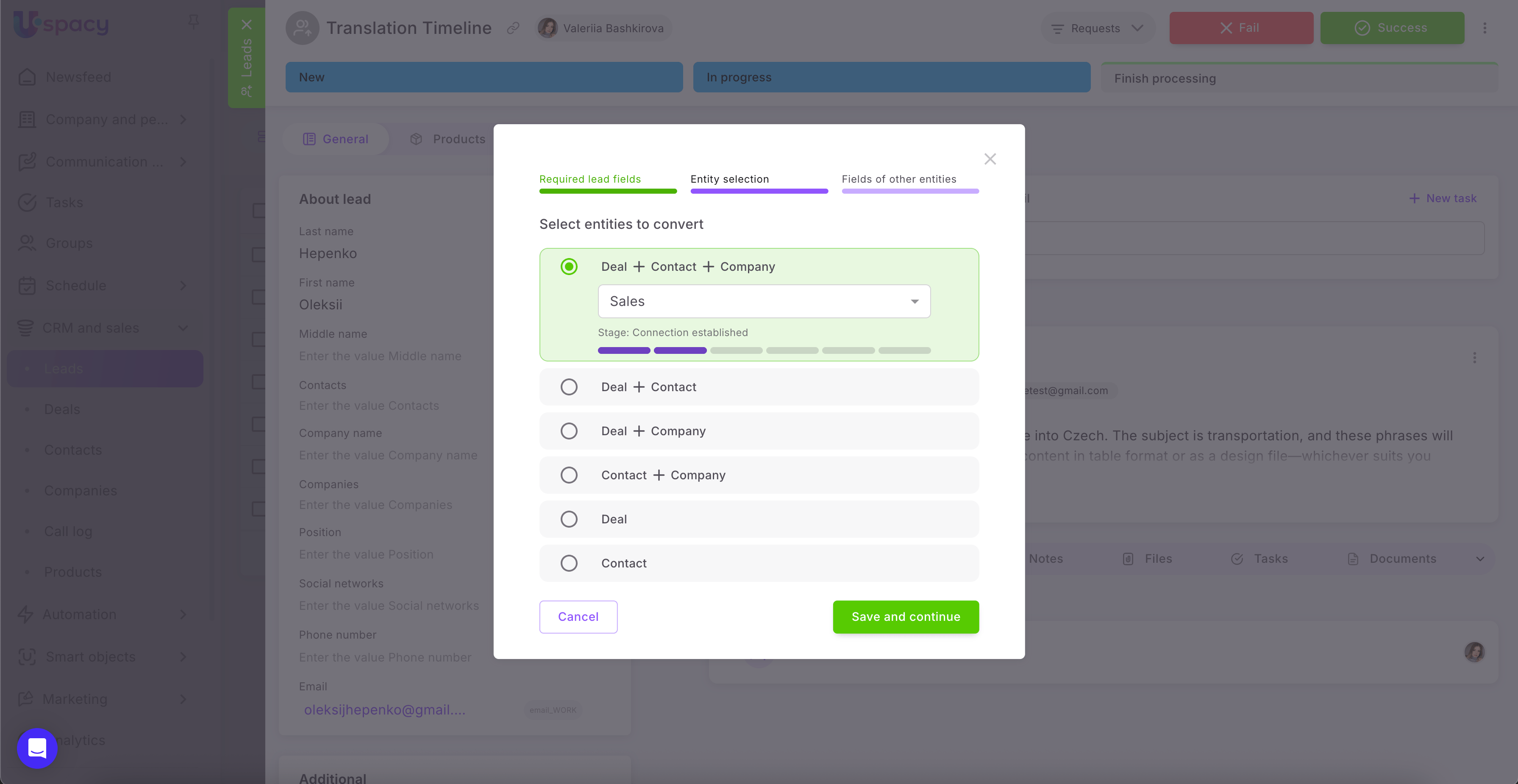
Uspacy is more than just a CRM — it’s a toolkit for managing clients, processes, and communications all in one place. By keeping leads and deals separate, this model scales easily as your business grows. You can quickly test this logic in your own company, even if you haven’t used a CRM before.
Conclusion
In short, the formula is simple: lead = potential, deal = a specific sales opportunity with projected income. Leads show how your acquisition channels are performing, while deals show how the sales team converts that flow into income.
Properly separating these entities provides transparent analytics, clear roles for marketing and sales, and realistic expectations for the team. Managers stop “reading between the lines” in reports and start working with clear numbers.
Uspacy helps embed this logic in the CRM so that it lives not just in the manager’s head, but in the daily workflow of the team. The easiest way to see the difference is to activate a Uspacy demo, enter a few real leads, and take them through the full path to a deal. After that, the question “how are they different?” usually disappears.
Updated: December 1, 2025
More materials on the topic

Forecast or guesswork over coffee grounds? How to plan quarterly sales using Uspacy data
April 10, 2026

Chaos, eliminated: How a unified document registry in CRM saves deals and hours of work time
April 8, 2026

Forgotten appointments and lost revenue: How automated reminders prevent client “amnesia”
April 6, 2026
FAQ
What is the main difference between a lead and a deal in a CRM?
When should a lead in a CRM be converted into a deal?
How does a CRM help manage leads and deals without confusion?
Uspacy is improving and developing at an incredible speed
Learn about product development plans
Uspacy roadmap 🚀