Where businesses really lose deals — and it’s not price or competition
June 10, 2026
7-minute read

Dmytro Suslov

A deal may still remain open in CRM, but in reality it is already moving toward loss. The reason is often not the market, but internal breakdowns: the team did not follow up in time, did not record the next step, or lost context. It is from these small failures that deal loss actually begins.
A client submits a request. A manager quickly responds, holds a conversation, clarifies the need, and agrees to return the next day with details. At this stage everything looks fine. But “tomorrow” gets lost among new calls, emails, messages, and internal tasks.
The deal is still technically in the CRM. The contact has not been deleted. The status has not been marked as closed. But in reality, the sale has already begun to lose momentum. The customer is waiting, interest is fading, and the company does not even notice the moment when the opportunity starts slipping away.
This is how sales are often lost. Not because of price. Not because of a stronger competitor. And not because of a lack of demand. More often, the reason is much simpler: an agreement was not documented, a task was not created, context was not shared, a message was missed, or no one followed up in time.
In this article, we will examine where deals most often stall and how Uspacy helps keep sales under control.
Sales are lost in the details: how small gaps lead to lost deals
A lost deal is rarely the result of one major mistake. More often, it is the outcome of a series of small breakdowns that accumulate day after day. One sales rep fails to update a status. Another does not create the next follow-up task. A third forgets to log an important detail after a call.
The problem is that these small issues rarely seem critical at the moment. Yet they are exactly what slows down the sales process. The customer does not receive the promised document. They do not get a response when they expect one. They have to repeat information they already shared the day before. Trust erodes faster than reports can reveal.
A CRM alone does not guarantee a sale. If the system functions as an archive of contacts and deals rather than a daily tool for managing next steps, managers only discover the problem after the fact. The deal may still be open, but the customer has already started conversations with another vendor.
To keep deals from stalling in the system, it is important to identify the first warning sign. More often than not, it starts with a simple phrase: “I’ll get back to it later.”
“I’ll get back to it later”: how delayed actions cost sales
The sales rep feels like everything is under control. After a call, they remember they need to send a proposal, clarify pricing, or schedule a demo. It seems impossible to forget something that important. But the workday quickly has other plans.
New leads come in, urgent emails require attention, internal approvals need follow-up, and other deals demand immediate action. What felt important an hour ago slips out of focus. The agreement remains “in someone’s head,” which means it is left unprotected from the chaos of daily work.
To the customer, this delay does not look like a busy team. It looks like indifference. The company failed to follow up when it said it would. That alone can be enough to weaken trust.
This is where sales are often lost. Not during major negotiations, but in the small moments: a proposal was not sent after the call, terms were not clarified, a payment-related question went unanswered, or the next conversation was never scheduled. Each of these pauses reduces the likelihood of closing the deal.
In Uspacy, these commitments should be immediately converted into a task, an activity, or the next step in the deal. That way, “later” does not eventually become “never.”
“Create a task” doesn’t mean “keep the deal moving”
At first glance, creating a task seems to solve the problem. The sales rep records the next action, sets a due date, and moves on. In practice, however, that is not enough. A note that simply says “call the customer back” does not protect a deal if there is no visibility into which conversation led to the task, what needs to be clarified, what stage the deal is in, or what outcome is expected from the follow-up.
In Uspacy, tasks are more effective when they are used not as standalone reminders but as part of a process. Users can assign an owner, add collaborators, set deadlines and priorities, include comments, create subtasks, and build checklists. As a result, the team sees more than just an action item—it sees a structured framework that defines who is responsible, what needs to be done, and by when.
It is also worth highlighting the connection with CRM. In sales, it is important not only to create a task but also to preserve its context. In Uspacy, this role is strengthened by activities, which can be linked to leads, deals, contacts, companies, and tasks themselves. As a result, the next action does not exist separately from the sales process but remains tied to a specific customer and a specific deal.
Another powerful use case is automation. If a deal moves to a new stage, Uspacy can automatically create a task—for example, to prepare a commercial proposal, schedule a demo, or follow up with the customer the next day. This reduces manual routine and eliminates the common problem of sales managers keeping the next step only “somewhere in their head.”
As a result, teams do not operate according to the principle of “there’s a task, so everything is under control.” Instead, they work with a different logic: there is a customer, there is a deal, there is a next action, there is a deadline, and all the necessary context is available in one place. That is when a task truly helps keep a deal moving forward rather than simply adding another line to a to-do list.
Customer messages everywhere: how communication gets lost in CRM
Customers do not separate communication by channel. A lead may come through a website form, continue in a messenger, be clarified over email, and be finalized in a phone call. From the customer’s perspective, this is one continuous conversation with the company. From the business side—without a unified workspace—it becomes a set of fragmented interactions that must be manually connected. This is how multichannel chaos appears: one manager sees an email, another sees a chat, and a supervisor only sees the deal status in CRM
In Uspacy, this gap is closed by the Communication hub. It brings together digital channels, live chat, and email into a single workspace. Messages from messengers and social networks arrive in one unified inbox, email and website conversations are logged in the system, and the team works without constantly switching between tools.
In sales, it is not enough to receive an inquiry—it must immediately be tied to the process. In Uspacy, messages from messengers are saved in CRM records, users can quickly navigate from a CRM card to the relevant chat, and the system can automatically create a lead from the first interaction. Live chat and email work the same way: communication does not exist separately from sales but becomes part of a unified customer history
This becomes clear in a simple comparison. If a manager negotiates via a personal messenger, keeps tasks in notes, and tracks deal status in spreadsheets, leadership only sees fragments of the process. In Uspacy, communication, CRM, tasks, and follow-up actions operate in one environment, giving the team full context, faster response times, and fewer lost deals caused by fragmented communication history.
How Uspacy helps keep a deal “alive”
A live deal is not just a card marked “in progress.” It is a process that moves forward without pauses or breakdowns. That is why in Uspacy, CRM is designed not as an archive of contacts but as a tool for managing daily sales activities and customer interactions. A sales manager does not work around the deal but within a single context where the stage, logic of movement, and everything needed for the next step are clearly visible.
The biggest driver that keeps a deal “alive” is automation. In Uspacy, you can configure workflows with conditions, branches, delays, and notifications, triggered by lead or deal creation, stage changes, status updates, field changes, or assignment of an owner. In practice, this means something simple: the system actively pushes the process forward—it creates required actions, updates data, changes stages, and triggers routine steps without constant manual control. The deal does not get stuck between “don’t forget to do it” and “why haven’t we followed up yet.”
Another strong capability is analytics, which shows not only final outcomes but also early signs of lost momentum. In Uspacy, this is supported by dashboards, reports, and specific metrics such as “Company rhythm” and “My productivity.” Managers can see weak points in the process, lead sources, average deal duration, unprocessed leads, and overdue actions. This makes problems visible long before the customer is actually lost.
As a result, Uspacy works not as a standalone tool, but as a unified workspace where sales does not break into disconnected pieces. A deal is not just stored in the system waiting for attention—it continuously has direction and movement. That is the key difference between a formally “open” deal and a truly active one.
Conclusion
It is usually neither price nor competitors that cause a deal to be lost. Much more often, businesses lose sales earlier—due to delayed responses, missed actions, tasks without context, or communication that never made it into CRM. A deal rarely “dies” in a single moment. More often, it gradually loses momentum, and with it—the chance of success.
That is why CRM should not be just a place for storing contacts and deals. It should function as a living sales management system. When tasks, Communication hub, automation, and analytics are connected, teams respond faster, stay focused on the next step, and rely less on the human factor.
Uspacy provides exactly this approach. It is not just a CRM, but a comprehensive set of tools for managing business in one workspace. As a result, sales do not break into disconnected actions, but remain a controlled process with clear ownership, deadlines, and a well-defined logic of movement.
Updated: June 10, 2026
More materials on the topic
Internet payment processing in CRM: how to accept and track payments with Uspacy as an example
The client has agreed to the purchase, and the sales manager has confirmed the details and finalized the price.
October 9, 2026
Weblium and Wix inquiries and orders: how to build a streamlined CRM process
A website helps you showcase your business, collect inquiries, and accept orders.
October 7, 2026

Documents without manual work: how to automate the creation and sending of invoices, acts, and contracts
September 2, 2026
FAQ
Why do businesses lose deals even when they use a CRM?
Why isn’t one task enough to keep a deal moving?
How does Uspacy help prevent lost deals?
Who benefits most from a unified approach to sales, tasks, and communication?
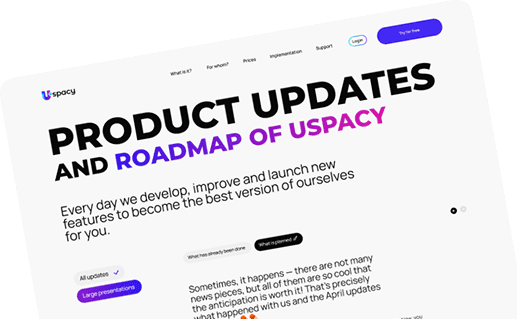
Uspacy is improving and developing at an incredible speed
Learn about product development plans
Uspacy roadmap 🚀